Enterprise AI delivery / Implemented controlled pilot
State Engine and Intelligent Routing
An agentic treasury solution that monitors liquidity and transfer events, prepares corrective plans and coordinates authorized actions across account, payment, approval and accounting systems.
Public-facing reconstruction of a controlled pilot implemented with 3–5 selected banking clients. The pilot addressed a post-submission transfers blocker, enhanced the client-facing experience and included AI-enabled decisioning informed by available liquidity. Screens use fictional data and illustrate the workflows. Broader roadmap capabilities are identified separately.
Updated November 5, 2026 · Controlled pilot, solution workflows and system integration
Manage changes before execution
The client problem
An immutable downstream group identifier can prevent adding, removing or changing transfer lines after submission. A small correction may require cancellation, reconstruction and resubmission, with consequences for approvals, funding, timing and reconciliation.
Funding can also change without an edit: another manager consumes shared-account funds or an expected incoming payment arrives late.
My product strategy and solution design
I defined the State Engine requirements and partnered with engineering on a controlled pilot with 3–5 selected banking clients. The solution addressed the post-submission transfers blocker, improved the client-facing experience and used AI-enabled decisioning to factor available liquidity into transfer decisions.
My work covered specifications, user stories and acceptance criteria, coordination with technology, product, legal and compliance, and preparation for the client pilot. The broader agentic strategy below extends the pilot into additional treasury workflows.
The agentic strategy
Use a bounded treasury agent to carry an emerging problem from detection through resolution. The proposed agent monitors balance, transfer, approval and cutoff events; gathers relevant facts through approved tools; compares policy-eligible responses; and prepares a sequenced action plan. Once the required authorization exists, the orchestration layer coordinates permitted tool calls and checks their outcomes.
The State Engine provides the durable record of versions, approvals, reservations and execution status. The agent supplies contextual assessment and planning within those boundaries. A client can see what the agent found, why it recommends a response, which decisions require approval and what actually completed.
How the agentic workflow operates
- Observe: receive a funding change, requested edit, delayed approval or approaching deadline.
- Assess: retrieve current balances, affected lines, processor status, policy and permissions; distinguish confirmed facts from forecasts.
- Plan: compare eligible remedies and prepare the required financial instructions, change summary and approval requests.
- Act within authority: hand approved actions to controlled services; sequence dependent steps, reconcile results and stop or escalate when conditions fail.
The client value is reduced investigation and coordination work: the agent prepares a usable resolution and follows its progress while the client retains consequential decisions. The controlled pilot implemented the transfers change experience and liquidity-aware AI decisioning. The broader detection-to-resolution agent workflow describes the solution strategy and further development scope.
One workspace across changing conditions
The State Engine records each group version, the outcome of each transfer line and the funds reserved for it. It preserves the client’s reference while coordinating the downstream instructions required to revise or execute the group.
Client intent
Fund an account, consolidate cash, distribute funds or cover a shortfall.
Versioned workspace
Retain proposed changes, line identity and approval history.
Funding and policy
Check permissions, reservations, limits and current authorization.
Resolution preparation
Assess affected lines, compare eligible remedies and explain consequences.
Controlled handoff
Release only after funding, approval and confirmed processor conditions permit it.
Outcome and lineage
Reconcile acknowledgements, actual money movement and external accounting references.
Two change paths with explicit execution boundaries
| Confirmed lifecycle position | Required behavior |
|---|---|
| Submitted by the client and held upstream | Create a new version, explain the impact, obtain full authorization of the revised package and revalidate before handoff. |
| Accepted downstream and eligible for cancellation | Prepare the replacement, but block its release until the affected originals are confirmed non-executable and the replacement is authorized. |
| Cancellation or submission outcome unknown | Reconcile status before retrying. A sent request or an updated screen cannot establish completion. |
| Execution committed or settled | Do not edit or resubmit committed lines. Offer a separate supported recovery process without promising a successful return. |
The client’s group policy determines whether unaffected lines may proceed independently. A mixed-rail group does not imply all-or-nothing settlement. A review focused on the changes still authorizes the complete revised package; prior signatures are not silently carried forward.
Agentic solutions for liquidity and transfer exceptions
The strategy applies to four connected treasury problems. Each solution defines the event the agent responds to, the plan it prepares and the services needed to complete authorized actions.
| Solution and trigger | Agent responsibility and authorized handoff |
|---|---|
| Liquidity defense A current or projected shortfall affects pending transfers. | Assess shared-account demand, check eligible funding sources and prepare a sweep, funding change or deferral. After authorization, coordinate the funding instruction, confirm funds and recheck dependent payments. |
| Submitted group changes A client adds, removes or changes a line. | Assess execution status and change impact; prepare a revised package and approval request. Where cancellation is supported, coordinate a stop, confirm its outcome and release only an authorized eligible replacement. |
| Intelligent exception resolution A line cannot proceed or an outcome is uncertain. | Gather evidence, explain the blocker, prepare permitted next actions and route the item to its operational owner. Preserve quarantined data and reconcile uncertain outcomes before retrying. |
| Routing and deadline management A route becomes unsuitable or approval delay threatens timing. | Compare eligible routes or delegated signatories, prepare a revised plan and disclose timing, fees and approval consequences. Required policy and authorization checks govern the handoff. |
Funding and reconciliation requirements
Real-time monitoring checks shared-account commitments and changing balances. Predictive liquidity estimates future pressure, while authoritative funds and effective reservations determine whether a payment may actually release.
A sweep is a separate financial instruction with its own authorization. Credit draws, cross-entity funding and FX rebooking require additional provider and policy validation. Faster routing alone cannot resolve a funding shortfall.
How the agent integrates with treasury systems
The proposed agent accesses systems through permission-scoped tools and APIs. The State Engine coordinates durable workflow state and controlled adapters between the client workspace and existing services. The following contracts describe integration responsibilities across the broader solution. The controlled pilot covered the transfers blocker and liquidity-aware decisioning; the table also includes expansion requirements.
| Integration | Data and actions | Control and outcome |
|---|---|---|
| Account ledger and reservation service | Read current balances, commitments and holds; request approved reservations or funding instructions. | Authoritative funding checks prevent double commitment within confirmed coverage. Forecasts remain separate from spendable funds. |
| Core processor and payment rails | Read line status and capabilities; submit authorized instructions or supported cancellation requests through adapters. | Confirm cancellation before replacement release. Reconcile uncertain writes and never resubmit committed lines. |
| Entitlements, policy and approval services | Resolve allowed actions and signatories, retrieve approved policy guidance and request required signatures. | Current permissions and approvals govern each consequential action. A policy explanation cannot grant execution authority. |
| ERP and cash accounting | Map original business references to versions, replacement groups and line outcomes; emit recoverable status events. | Preserve reconciliation through splits and retries. A sent callback does not prove a client ledger posting. |
| FX and credit providers | Validate quotes, facility availability, terms and permitted rebooking or draw requests. | These are later capabilities with separate provider, policy and approval requirements. |
Example of coordinated execution
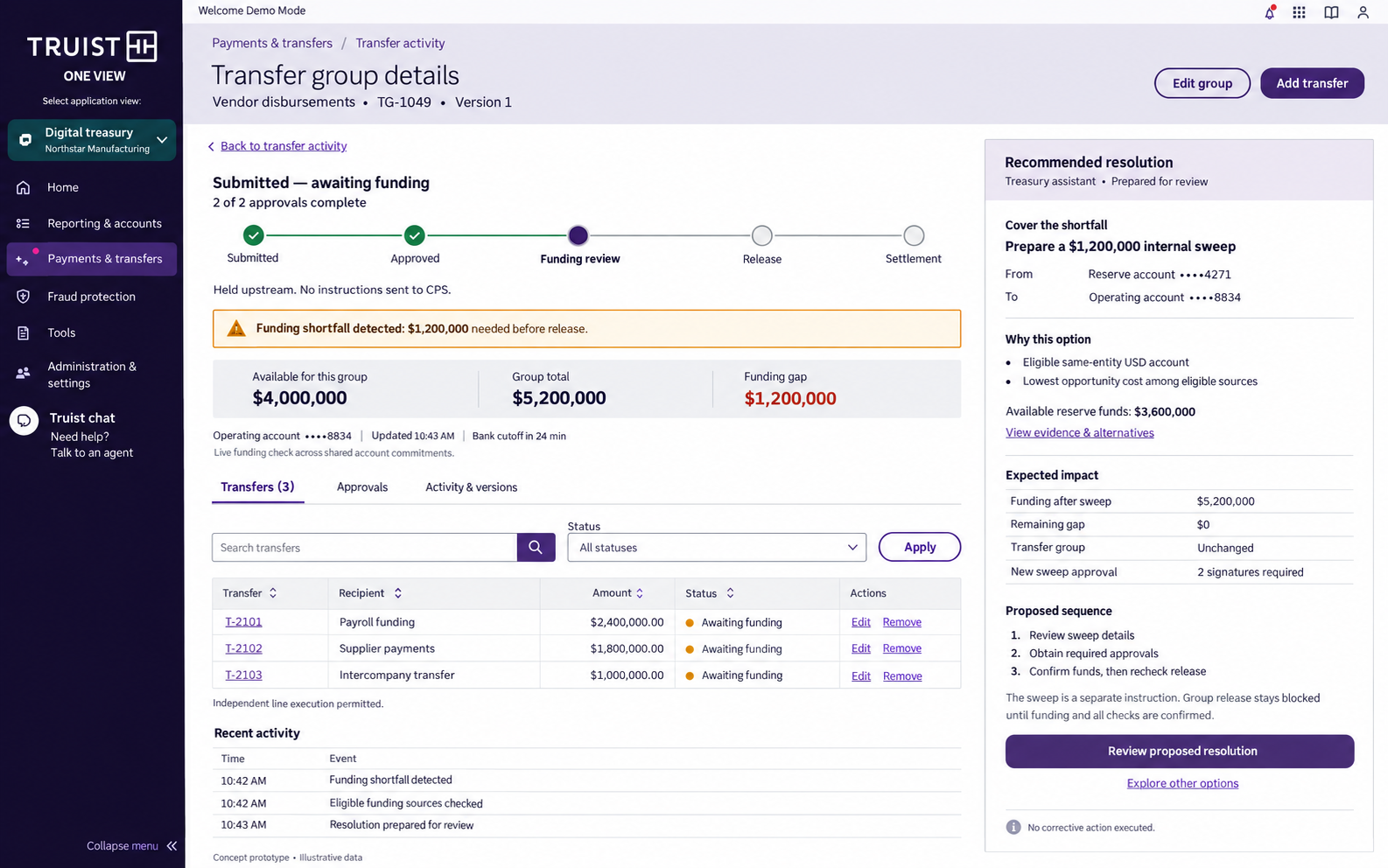
For the illustrative $1.2 million shortfall, the agent reads account availability and pending commitments, compares eligible same-entity funding sources and prepares the sweep and its approval request. After the required signatures, controlled services submit the sweep and verify the result. The State Engine then rechecks funding and payment eligibility before group release and records the linked outcomes for accounting.
Each step records its operation identity and confirmed outcome. If funding fails, a permission changes or a response is uncertain, the workflow blocks dependent release and reconciles or escalates. Repeated requests must resume the same operation rather than create a duplicate payment.
Agent-prepared funding resolution
This proposed One View-style surface shows the agentic strategy in the client workflow. The treasury agent detects a $1.2 million gap, uses account and policy integrations to compare eligible funding sources, and prepares an internal sweep with its approval handoff. The panel exposes the plan, evidence, expected impact and remaining decisions; activity history makes the agent’s progress visible.
What the agent prepares and what the client controls
- Detection and preparation are distinct from authorization and confirmed execution.
- The proposed remedy leaves the group unchanged; editing its material details would create a new version and require reapproval.
- Activity history records what was checked, what was proposed and what still needs a client decision.
Proposed UI wireframes
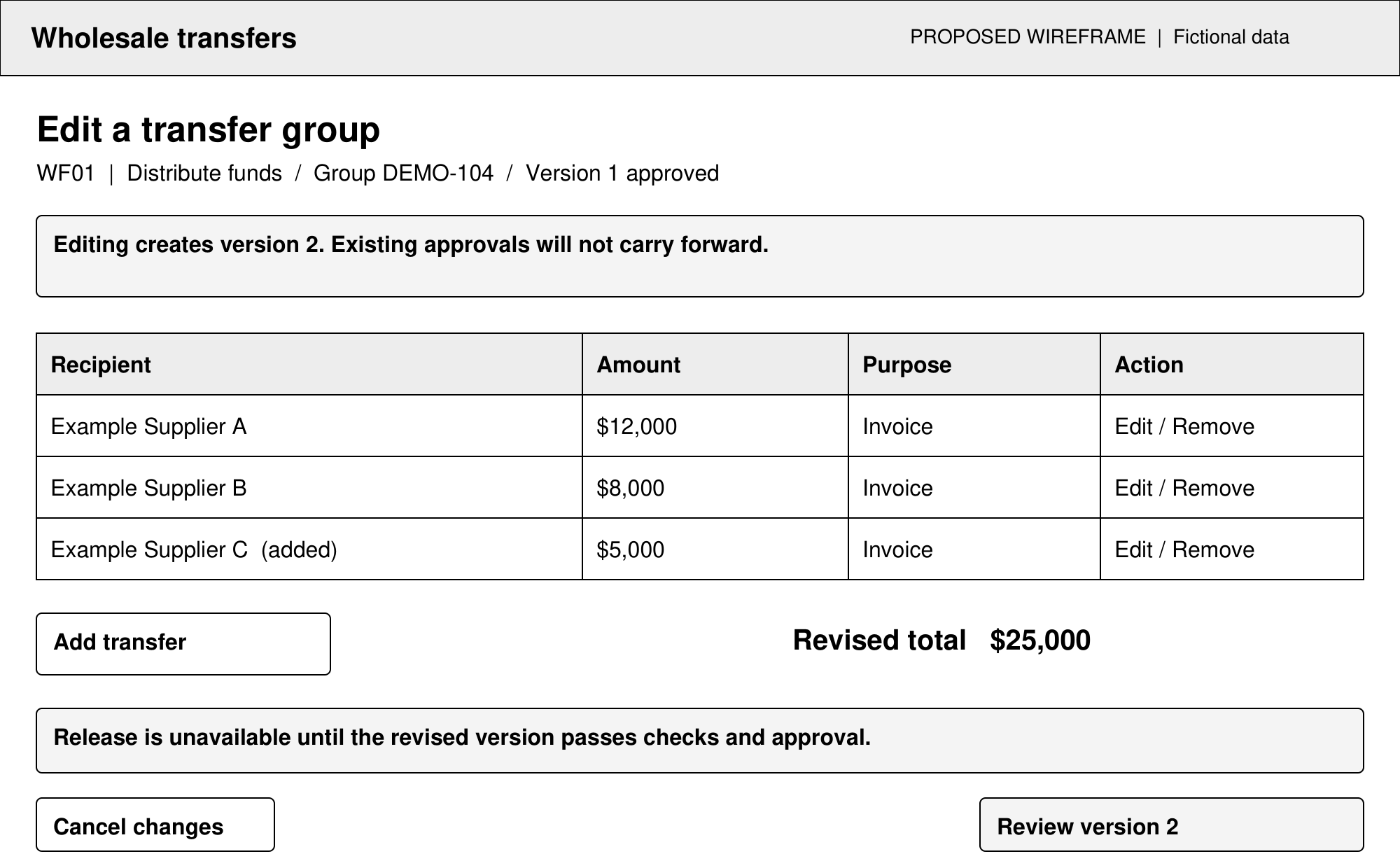
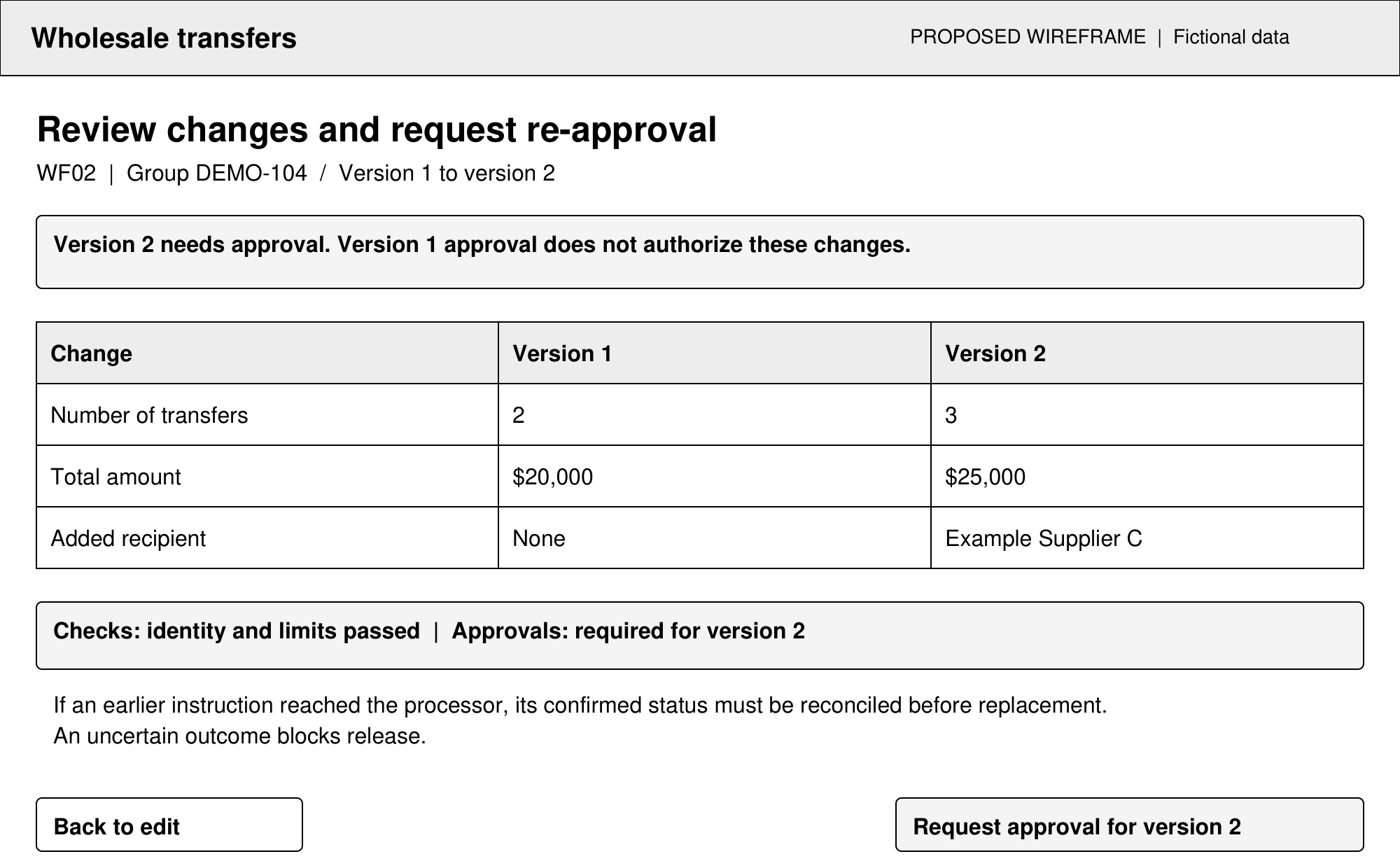
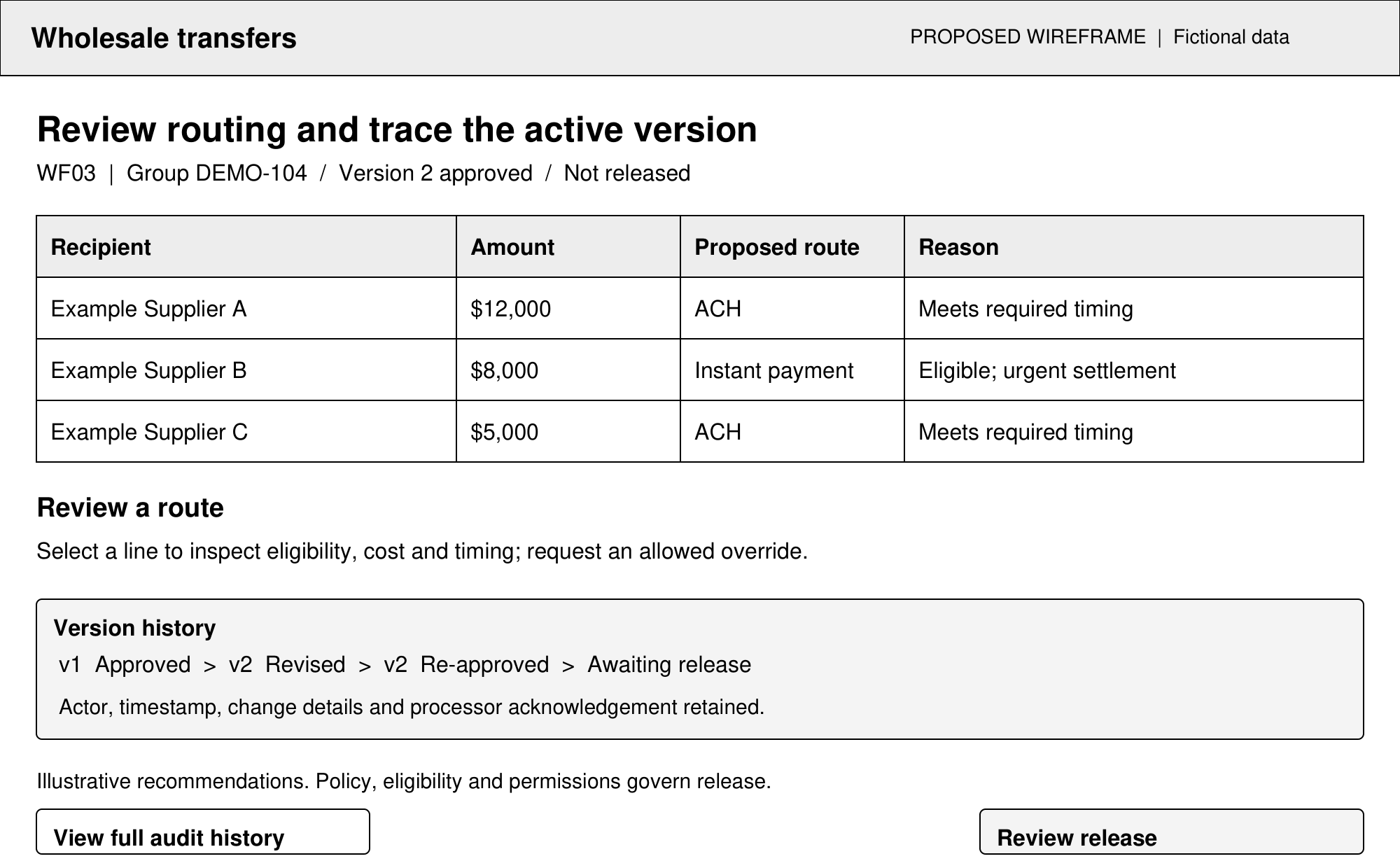
These earlier low-fidelity studies explore group edits, reapproval and routing. They remain supporting design references; the lifecycle and controls described above reflect the consolidated requirements. All entries are fictional and the screens are not implemented behavior.
WF01 Edit a transfer group
WF02 Review changes and request re-approval
WF03 Review routing and trace the active version
Agent autonomy and execution controls
The proposed agent can independently gather authorized evidence, assess alternatives and prepare plans within its tool permissions. Financial actions flow through deterministic services only after their required authorization and validation. The agent cannot create approval authority, override a blocked release or infer success from generated text.
Evidence and recommendations
Validated APIs supply balances and transaction status. Approved, permission-filtered policy sources can support explanations through retrieval-augmented generation. Missing, conflicting or stale evidence triggers review or abstention.
Execution authority
Entitlements, full revised-package approval, confirmed funding and processor status govern release. Generated text cannot approve a sweep, confirm cancellation or establish settlement. Tool permissions, stopping rules and recovery paths must be explicit.
Routing first filters for policy, funding and destination eligibility, then compares cost, urgency and observed reliability. Client overrides remain subject to the same controls. These are requirements for proposed capabilities, not evidence of a deployed agent or retrieval service.
Validation and product roadmap
The consolidated specification includes acceptance scenarios for material edits, confirmed cancellation, uncertain outcomes, partial execution, concurrent funding, reservation expiry, authorized remedies, FX and route changes, accounting replay, hostile AI inputs, outages and accessible recovery.
| Critical scenario | Required result |
|---|---|
| Material change after approval | The prior approval cannot release the revised package; the client can inspect the changes and full replacement. |
| Cancellation times out or a line has settled | Unknown outcomes remain blocked and are reconciled. Committed lines are never included in replacement execution. |
| Two managers compete for funds | The same funds cannot be reserved twice within the declared control scope. External-channel coverage is explicit. |
| Remedy fails or evidence is stale | The dependent payment remains blocked. The client receives an accurate status and a safe next action. |
| Accounting endpoint or orchestrator restarts | Replay and recovery preserve lineage without duplicate payments or false completion. |
Staged delivery
- Discovery and capability validation: confirm cancellation contracts, reservation coverage, approval scope, group policy and baselines.
- Deterministic prototype and integration contracts: test versions, reservations, authorization, downstream adapters and recovery; define the agent’s tools, event inputs, allowed actions and stopping rules.
- Implemented controlled pilot: partnered with engineering to deliver the transfers blocker fix, client-facing enhancements and liquidity-aware AI decisioning to 3–5 selected banking clients.
- Controlled expansion: validate support, reconciliation and capacity before expanding clients and rules-based routing.
- Predictive liquidity and agentic resolution: evaluate forecasts and proposed plans in shadow mode, then enable evidence-backed recommendations and authorized remedy coordination after evaluation.
- Advanced orchestration: assess credit draws, cross-entity funding, FX rebooking, broader rails and agent assistance as separately gated capabilities.
Controlled pilot with 3–5 selected clients
The capability was implemented for a limited cohort of 3–5 banking clients. The pilot combined the post-submission transfers blocker fix, client-facing experience enhancements and AI-enabled decisioning that considered available liquidity. Access was restricted to the selected clients. The term sandbox in the interview referred to this restricted client cohort.
The broader roadmap calls for evaluating agent evidence selection, plan validity, tool permissions, approval handoffs, outcome verification and stopping behavior before expanding autonomy or enabling additional remedies.
Progression requires passing the applicable failure and recovery tests, complete lineage, reconciled reservations and no duplicate or unauthorized releases. Proposed learning targets are at least 90% task completion and impact comprehension, and 50% fewer manual cancellation, duplication and re-entry steps in matched scenarios. These thresholds require agreement before testing; report raw counts alongside percentages and treat findings from a small cohort as directional.
Pause affected live capabilities for duplicate execution, unauthorized release, resubmission of a committed line, unexplained reservation differences, material reconciliation failures or data disclosure. Keep in-flight status reconciliation running during containment. If downstream cancellation is unvalidated, restrict the test to upstream changes and record that limitation.
The controlled pilot was implemented with 3–5 selected clients. Expansion phases, advanced agentic remedies and the numerical learning targets above remain roadmap items. Measured savings, model performance and achievement of those targets have not been established in this case study.
Enterprise AI product delivery
Evidence status: delivered capabilities and documented design are distinguished from proposed enterprise controls. The framework below states design and review requirements, not a certification.
Delivery status: A controlled pilot with 3–5 selected banking clients implemented the transfers blocker fix, client-facing enhancements and liquidity-aware AI decisioning. Broader exception orchestration, routing, retrieval-assisted explanations and advanced funding remedies remain solution-design and roadmap scope. The mockups are public-facing illustrations of the workflows.
Control boundary: Deterministic policy, entitlements, approvals and confirmed processor status govern execution. An LLM may explain validated decisions or prepare support/test material; generated text cannot authorize a payment, establish eligibility or confirm execution.
Proposed RAG: Retrieve approved, permission-filtered policy and operational guidance with version/source references for explanations. Live transactional facts must come from validated system APIs. Missing or conflicting evidence triggers abstention or review; retrieved text never overrides execution controls.
| Capability | Product decisions and assurance requirements |
|---|---|
| Business value and solution selection | Define outcomes and baselines; compare rules, automation, LLMs, retrieval and agents against risk, accuracy, speed, cost and complexity. |
| Requirements and specification alignment | Trace business goals to UI behavior, agent/tool contracts, data/API requirements, exceptions and measurable acceptance criteria. |
| Prompt and context engineering | Use intent, grounding, controls, interaction rules, execution/output contracts and assurance. Version prompts and test normal, missing, conflicting and hostile inputs. |
| RAG and knowledge quality | Retrieval-augmented generation retrieves approved information to support answers. Specify permissions, source freshness, citations and insufficient-evidence fallback; evaluate retrieval and answer accuracy separately. |
| Agent control and orchestration | Define responsibilities, tools, memory, handoffs, least-privilege access, stopping conditions and human approvals. Keep generated recommendations separate from authorized execution. |
| Data and integration | Specify schemas, API contracts, mapping, validation, revisions, synchronization and duplicate prevention; reconcile uncertain writes before retrying. |
| Security and privacy | Classify sensitive data, minimize collection, protect credentials, restrict access, and define retention/deletion. Treat external content as untrusted; test prompt injection and disclosure risks. |
| Governance and compliance | Identify policy obligations, accountable owners, security/risk/legal reviews, audit evidence and vendor dependencies. Alignment requires review; documentation alone does not establish compliance. |
| Hallucination mitigation | Ground claims in approved sources, verify citations, expose uncertainty and abstain or escalate when evidence is insufficient. Retrieval cannot guarantee a correct answer. |
| Validation during operation | Validate input, retrieved evidence, output structure, business rules and action authorization before downstream use; use human review for consequential actions. |
| Evaluation and QA | Use repeatable cases for accuracy, unsupported claims, bias, security, edge cases and recovery. Set release thresholds and rerun after model, prompt or retrieval changes. |
| UX and accessibility | Expose source evidence, status and uncertainty; support review, correction, cancellation and recovery. Validate keyboard use, focus, labels, contrast and accessible status messages. |
| Performance and economics | Define acceptable response time, throughput, reliability and cost per useful outcome. Evaluate delivery speed separately from application speed; establish measured baselines before claiming gains. |
| Deployment and operations | Plan environments, controlled releases, logs with sensitive-data protection, alerts, incident ownership, rollback and ongoing model/prompt monitoring. |
| Leadership and adoption | Align business, engineering, UX, QA, security, compliance and support through priorities, decisions, training and clear ownership. |
| Roadmap and improvement | Prioritize evidence from users, evaluation and incidents; distinguish current capability from proposed enhancements and enterprise deployment prerequisites. |
Example acceptance requirements
Material changes invalidate prior approval. Uncertain processor status blocks replacement until reconciled. Committed lines are never resubmitted. Funding remedies require their own controls, and forecasts cannot substitute for confirmed funds. Explanations identify approved policy sources.