AI solutioning / Independent application delivery
Job Search Manager
AI-enabled workflow application: end-to-end product discovery, specification, accessible design, agentic orchestration, integration and deployment.
A deployed private application with external agentic workflows. Public visuals contain fictional entries. The career research and relationship enhancement is proposed.
One workspace for the next useful action
The problem
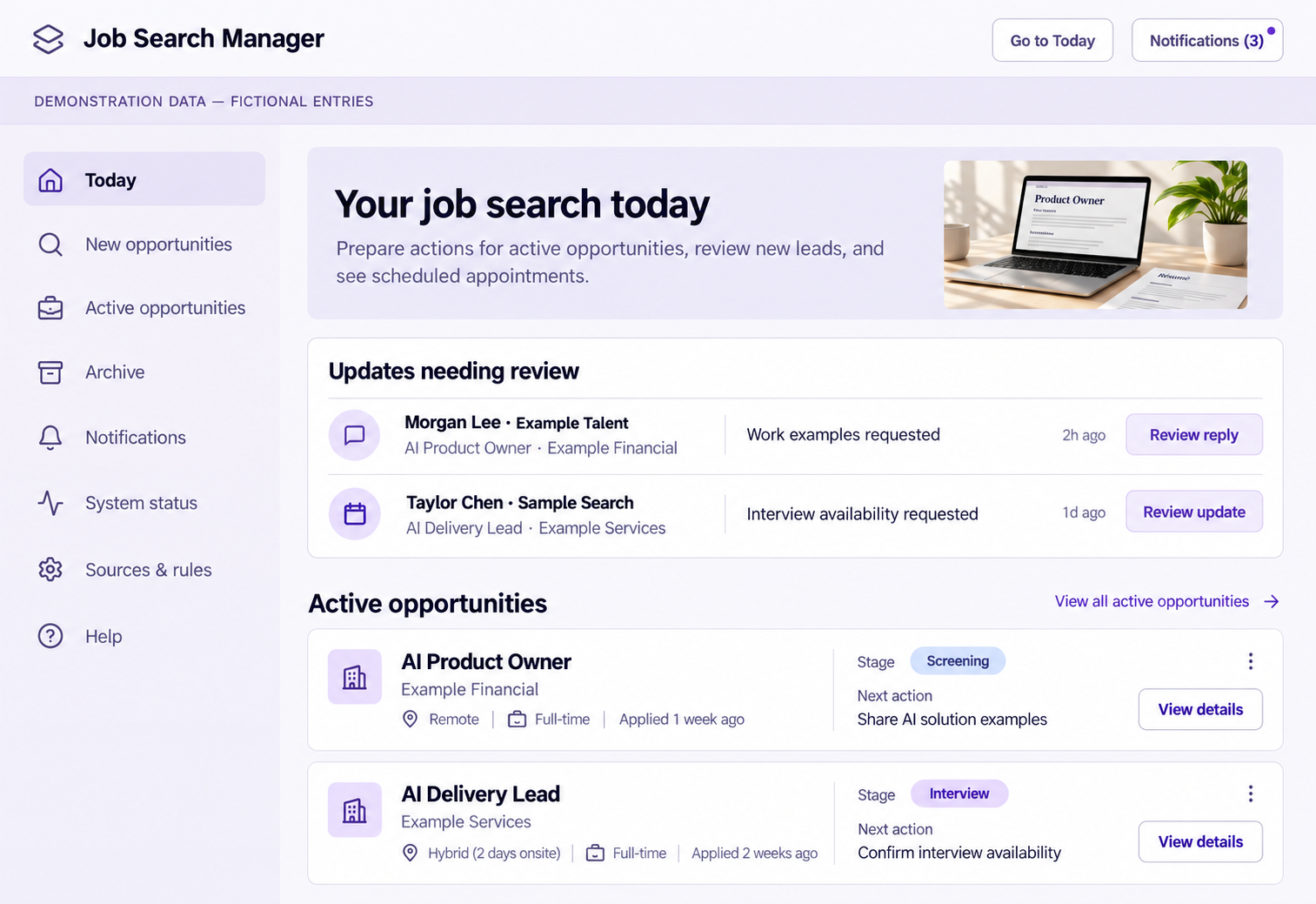
Recruiter messages, opportunities, drafts and follow-ups were scattered. Tracking a role still required repeatedly rebuilding the context needed to act.
My contribution
I framed the problem, set priorities, specified behavior, made UI decisions and directed AI assisted implementation. I refined the product through use and specific feedback.
End to end multidisciplinary delivery
| Discipline | What I defined and delivered |
|---|---|
| Brainstorming | Expanded the tracker into a workspace for opportunity decisions, source context, replies, follow-ups and system health. |
| Business and technical requirements | Defined evidence-based stages, fit criteria, waiting ownership and deadline rules. Specified stable IDs, a canonical data contract, authorized writes, revisions and conflict handling. |
| UI and accessibility | Prioritized Today, actionable notices and replies beside their incoming message. Used explicit labels, responsive layouts and visible status text; formal accessibility verification remains a release check. |
| Coding and integration | Used AI assisted code generation, debugging and incremental refinement. HTML, CSS and JavaScript support the interface; typed backend routes connect validated APIs and persistent database state. |
| Deployment and inline QA | Delivered to private managed hosting with a serverless backend. Applied targeted regression checks, source review and external write readback during iteration. |
Agents supported by controlled APIs
| Agentic responsibility | Contract |
|---|---|
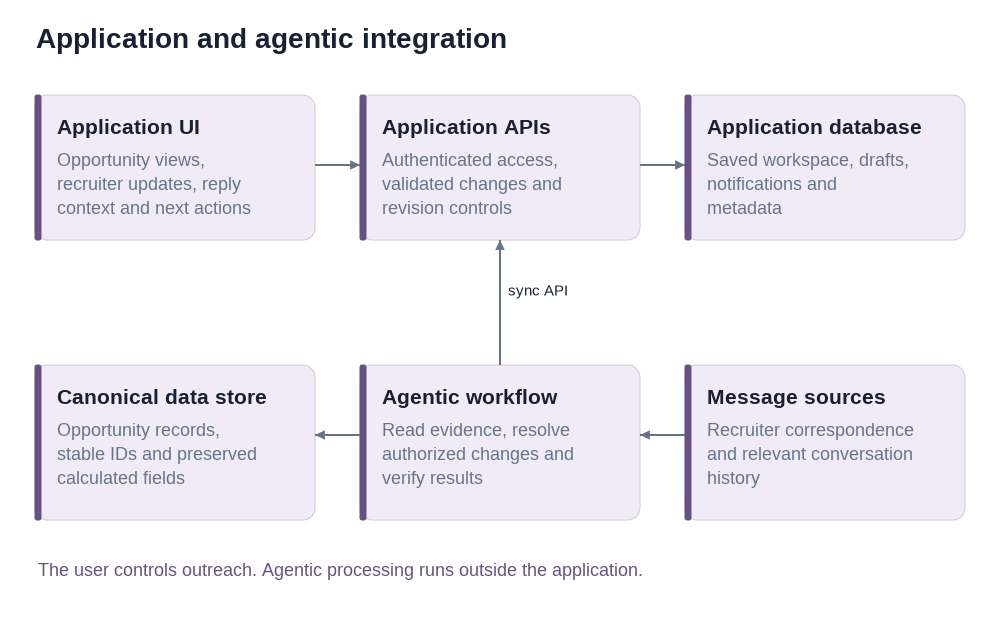
| Evidence reviewer | Read full recruiter messages, match records, extract supported facts and identify unanswered questions. |
| Data synchronizer | Process authorized edits, detect conflicts, preserve IDs and calculated fields, and verify writes before acknowledgement. |
| Update and reply coordinator | Publish deduplicated notices and prepare drafts tied to the selected message while preserving user edits. |
| Operational reporter | Report source coverage, successful checks, partial results and failures accurately. |
These are bounded roles within external orchestration, not separately deployed model services. No dedicated model training or in-application LLM inference endpoint is claimed. Configured routines and current activation are separate operational facts.
Prompt standards and quality controls
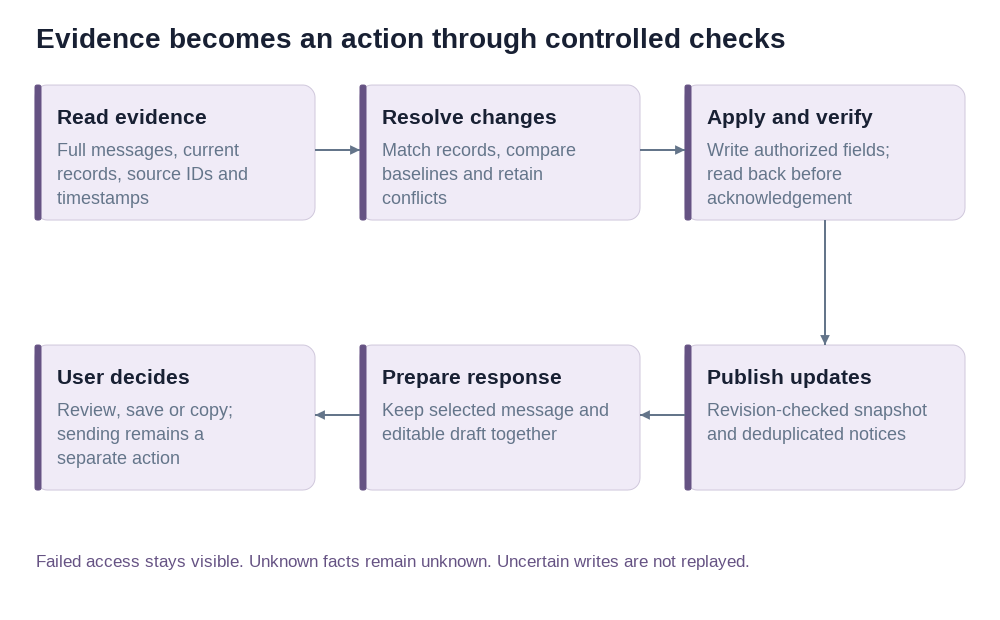
Prompts declare purpose, source authority, allowed actions, workflow, expected output and uncertainty handling. Retrieved messages are data, not instructions. Exact IDs, revision checks and readback protect changes. Drafting never authorizes sending.
Evidence and limits
Source code, workflow contracts and targeted tests support the design. Historical QA is not a fresh release certification; authenticated interaction and accessibility checks remain necessary.
Next enhancement
The PRD extends the product into sourced career research, contacts, conversations and referral support. It specifies typed records, bounded agent roles, acceptance criteria and a staged release plan.
Relevance to testing and support teams
The same pattern can support test evidence review, defect triage and support response preparation: grounded inputs, explicit agent responsibilities, controlled API writes and human review. These are transferable applications, not claims of delivered enterprise testing products.
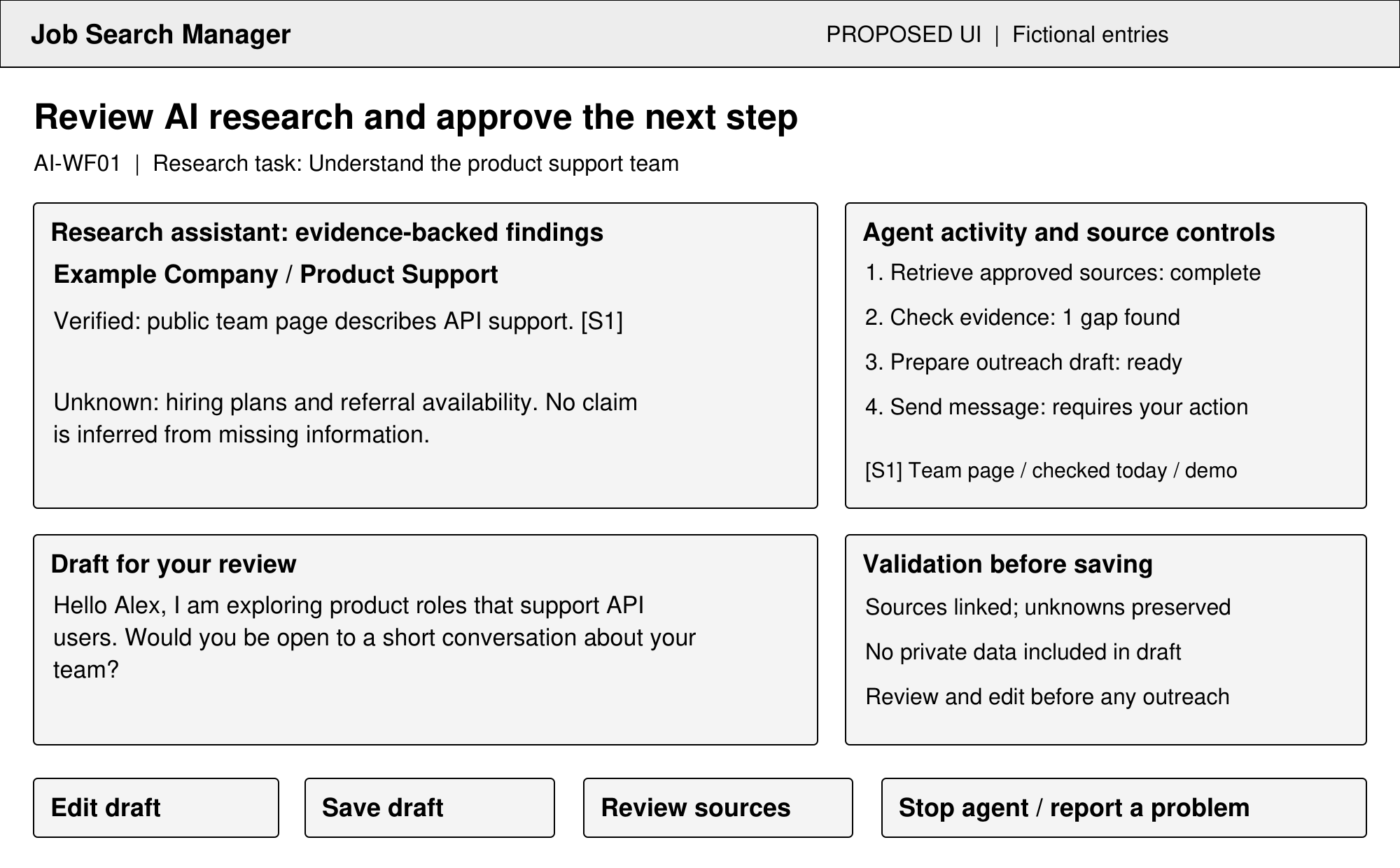
AI-WF01 Research and controlled outreach
Proposed enhancement: evidence-backed research, visible agent progress, explicit unknowns, editable drafts and user-controlled outreach. Fictional entries; this is not an implemented screen.
Enterprise AI product delivery
Evidence status: delivered capabilities and documented design are distinguished from proposed enterprise controls. The framework below states design and review requirements, not a certification.
Delivered scope: Independently delivered private workflow application, persistent database and controlled APIs, with external agentic orchestration. Existing source and workflow contracts support design claims; fresh runtime tests are required to certify current behavior. No dedicated deployed RAG pipeline, enterprise security certification or enterprise-scale performance is claimed.
Design evidence: Vendor-neutral prompt specification; bounded evidence review, synchronization, draft preparation and operational reporting; source authority, uncertainty handling, revisions and readback. Personal use supplies the problem context; the delivery demonstrates transferable AI product disciplines.
Enterprise extension: The framework below defines proposed requirements, not completed controls. Before broader deployment, validate owner/role-scoped authorization, data handling and retention, prompt-injection resistance, approved retrieval sources, operational monitoring and release thresholds with engineering, security, risk and compliance.
| Capability | Product decisions and assurance requirements |
|---|---|
| Business value and solution selection | Define outcomes and baselines; compare rules, automation, LLMs, retrieval and agents against risk, accuracy, speed, cost and complexity. |
| Requirements and specification alignment | Trace business goals to UI behavior, agent/tool contracts, data/API requirements, exceptions and measurable acceptance criteria. |
| Prompt and context engineering | Use intent, grounding, controls, interaction rules, execution/output contracts and assurance. Version prompts and test normal, missing, conflicting and hostile inputs. |
| RAG and knowledge quality | Retrieval-augmented generation retrieves approved information to support answers. Specify permissions, source freshness, citations and insufficient-evidence fallback; evaluate retrieval and answer accuracy separately. |
| Agent control and orchestration | Define responsibilities, tools, memory, handoffs, least-privilege access, stopping conditions and human approvals. Keep generated recommendations separate from authorized execution. |
| Data and integration | Specify schemas, API contracts, mapping, validation, revisions, synchronization and duplicate prevention; reconcile uncertain writes before retrying. |
| Security and privacy | Classify sensitive data, minimize collection, protect credentials, restrict access, and define retention/deletion. Treat external content as untrusted; test prompt injection and disclosure risks. |
| Governance and compliance | Identify policy obligations, accountable owners, security/risk/legal reviews, audit evidence and vendor dependencies. Alignment requires review; documentation alone does not establish compliance. |
| Hallucination mitigation | Ground claims in approved sources, verify citations, expose uncertainty and abstain or escalate when evidence is insufficient. Retrieval cannot guarantee a correct answer. |
| Validation during operation | Validate input, retrieved evidence, output structure, business rules and action authorization before downstream use; use human review for consequential actions. |
| Evaluation and QA | Use repeatable cases for accuracy, unsupported claims, bias, security, edge cases and recovery. Set release thresholds and rerun after model, prompt or retrieval changes. |
| UX and accessibility | Expose source evidence, status and uncertainty; support review, correction, cancellation and recovery. Validate keyboard use, focus, labels, contrast and accessible status messages. |
| Performance and economics | Define acceptable response time, throughput, reliability and cost per useful outcome. Evaluate delivery speed separately from application speed; establish measured baselines before claiming gains. |
| Deployment and operations | Plan environments, controlled releases, logs with sensitive-data protection, alerts, incident ownership, rollback and ongoing model/prompt monitoring. |
| Leadership and adoption | Align business, engineering, UX, QA, security, compliance and support through priorities, decisions, training and clear ownership. |
| Roadmap and improvement | Prioritize evidence from users, evaluation and incidents; distinguish current capability from proposed enhancements and enterprise deployment prerequisites. |
Example acceptance checks — proposed
An injected email cannot expand permissions. Unsupported facts remain unknown. Revision conflicts block writes; uncertain outcomes are reconciled before retrying. Sending requires user authorization.